
A facility services contract transition is the riskiest 90 days in any vendor relationship. The old team is leaving, the new team doesn’t know your site yet, and your production schedule doesn’t pause for either of them.
Usually, transitions don’t fail on day one. They fail quietly. A preventive maintenance task drops off the schedule. A badge request sits in a queue. A critical spare part was in the old vendor’s truck, not your storeroom.
Then, three months later, an air handler fails, and nobody can find the last service record.
That’s the real cost of a bad handoff. Not the disruption you see in week one. It’s the knowledge you lose without noticing.
Why a Facility Services Contract Transition Goes Wrong
First, knowledge walks out the door. Your outgoing vendor knows which chiller runs hot, which door reader sticks in winter, and which supervisor in Building 3 needs a heads-up before anyone enters. Yet very little of that is written down.
Meanwhile, the incoming vendor is under pressure to look ready. So they promise a smooth start and staff to the contract, not to the site. Those are different things.
In a secure facility, also add one more layer. Every new person needs badging, briefings, and sometimes a clearance check before they can work unescorted. Miss that timeline and your new vendor shows up on day one with a crew that can’t get through the gate.
On federal service contracts, the Continuity of Services clause (FAR 52.237-3) exists for exactly this reason. It can require the outgoing contractor to support phase-in and phase-out for up to 90 days. Use that window, or build the same expectation into your commercial contracts.
The 90-Day Facility Services Contract Transition Playbook
Break the transition into three 30-day phases: Capture, Mobilize, Stabilize. Each phase has one job. Don’t move to the next until the current one is done.
Days 1 to 30: Capture What the Old Vendor Knows
Here, your goal is to get site knowledge onto paper before it leaves.
- First, pull the full asset list, preventive maintenance schedule, and the last 12 months of work orders.
- Next, walk every critical asset with the outgoing lead technician. Record what they tell you.
- Also, inventory spare parts, tools, keys, and access devices. Note who owns each one.
- Finally, list every open work order and every recurring problem that “everyone knows about.”
Here’s a simple facility services contract transition test: if your best technician from the old vendor quit tomorrow, could the new team find what they need? If not, you’re not done capturing.
Days 31 to 60: Mobilize the New Team
Next, get the right people cleared, badged, trained, and on site.
- First, submit badge and access requests early. In secure facilities, this is the longest lead time on the plan.
- Then confirm which new workers can work unescorted and which can’t. Plan escort coverage for the gap.
- Next, load assets and preventive schedules into the new vendor’s work-order system, then check every entry against your list.
- Also, interview incumbent workers you want to keep. Site knowledge often lives with the people, not the paperwork.
- Finally, run a joint shift, old and new teams side by side, on your most critical systems.
Days 61 to 90: Stabilize and Prove It
At this point, the new vendor owns the work. Your job in this stage of the facility services contract transition is to confirm that nothing slipped.
- First, compare preventive maintenance completion against the baseline you captured in phase one.
- Then track response times for urgent calls. Compare them weekly.
- Next, close every carried-over work order or reassign it with a date.
- Finally, hold a 90-day review with facilities, security, and procurement in the same room.
Transition Scorecard: What to Measure
Above all, measure the same things before and after. Otherwise, a “smooth” facility services contract transition is just an opinion.
| Measure | Baseline (old vendor) | Day 90 target | Why it matters |
|---|---|---|---|
| Preventive maintenance completion | Captured in phase one | Equal or better | The first thing to slip in any transition |
| Open work order count | Captured in phase one | Lower, with dates on every item | Shows inherited backlog is being worked |
| Urgent response time | Captured in phase one | Equal or better | The number your operations leaders feel |
| Escort hours per month | Captured in phase one | Trending down | Shows the new crew is clearing access |
| Badge or access exceptions | Zero | Zero | Any exception is a security finding waiting to happen |
How One Integrated Vendor Shortens the Transition
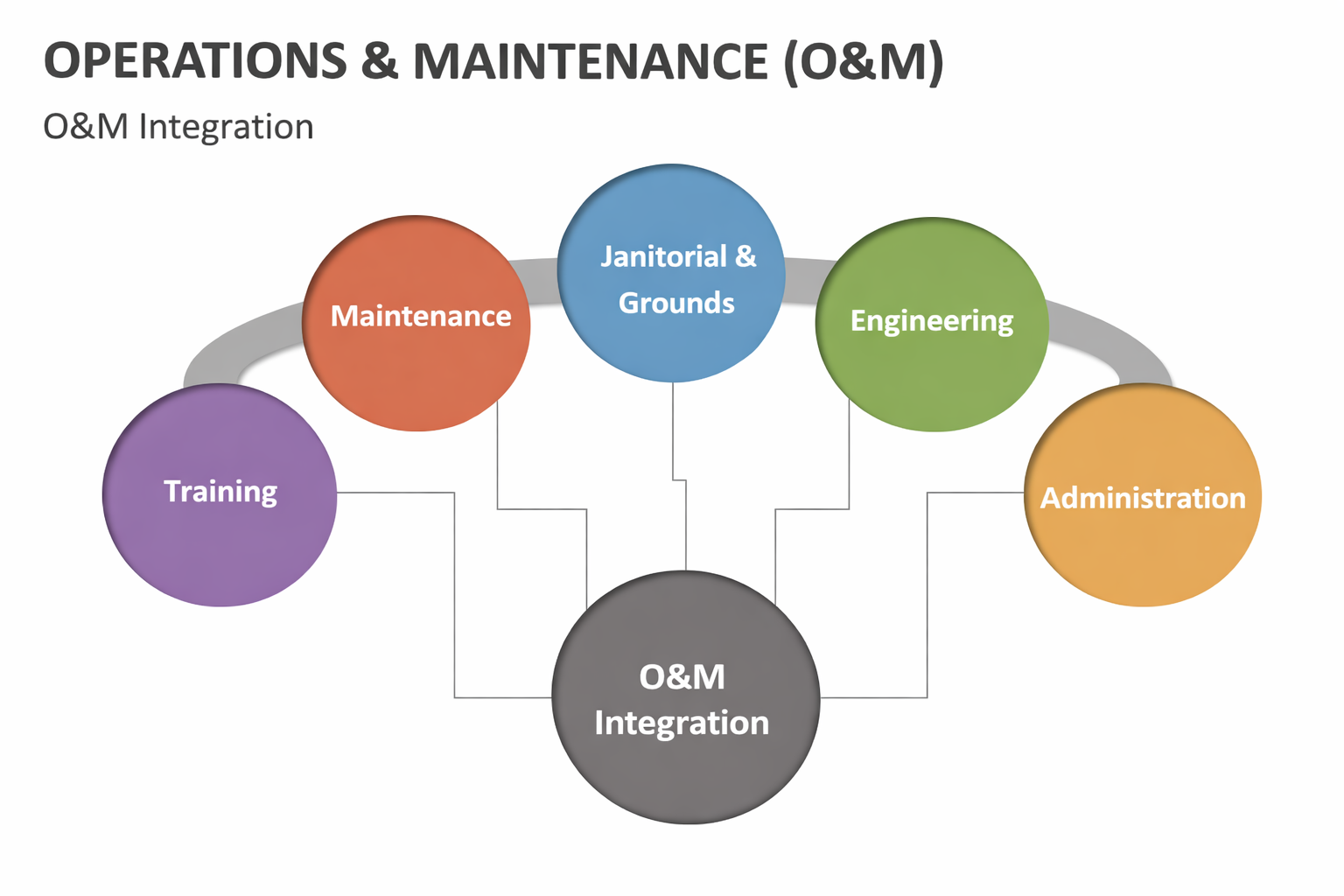
By comparison, changing four vendors means four transitions running at once. Four sets of badges, four knowledge transfers, four teams learning your site. That’s the fragmented vendor problem, multiplied by a deadline.
In contrast, consolidating into one self-performed provider turns that into one transition with one plan and one accountable manager. IH Services self-performs cleared maintenance, custodial, and grounds under one team, so you run one handoff, not four.
Questions Buyers Ask About Facility Services Contract Transitions
How long should a facility services contract transition take?
In general, plan for 90 days from notice to stable operations. Secure sites may need more time up front for badging and clearance checks, so start access requests as early as possible.
What is the biggest risk when changing facility vendors?
Lost site knowledge. Undocumented asset quirks, missing service records, and forgotten recurring tasks cause most post-transition failures, often months after the switch.
Should we keep the incumbent’s workers?
Often, yes, because experience matters. Experienced workers carry site knowledge that no document captures. Interview them early and keep the ones who know your critical systems.
Can the outgoing contractor be required to help?
On federal service contracts that include FAR 52.237-3, the outgoing contractor can be required to support phase-in and phase-out for up to 90 days. On commercial contracts, write that obligation in before you need it.
Plan the Exit Before You Need It
In short, the best time to plan a facility services contract transition is before you announce one. Capture the knowledge, mobilize early, and measure the result against a real baseline. Do that, and the switch becomes an upgrade instead of a gamble.
Planning a vendor change this year? Contact our team to walk through a transition plan for your site.
This article is general information, not legal or contracting advice. Confirm clause applicability with your contracting officer or counsel.