
Segment: intelligence facility services for SCIFs and accredited spaces
Intelligence facility services: cleared, self-performed, and approved before the first visit
Inside an accredited space, who is in the room matters more than what gets cleaned. So, IH Services staffs SCIFs, special access program facilities, and the controlled areas around them with its own employees, approved through a dedicated Facility Security Officer, under one agreement per site. As a result, your special security officer gets a fixed roster, an access record for every entry, and one accountable name.
IH Services provides intelligence facility services: custodial inside accredited spaces, industrial housekeeping, grounds and exterior, waste and recycling, and mechanical, electrical, and plumbing maintenance, all under one site manager and one escalation path. The accrediting agency and the site’s special security officer set the rules; IH Services sponsors and maintains personnel approvals through a dedicated Facility Security Officer trained to 32 CFR Part 117 under DCSA, and runs every task through R3 Secure FacilityOps so the access, completion, and corrective-action records are ready when the security office asks.
Why intelligence facility services are different
An accredited space shares the security perimeter of any cleared site. Then, it adds three conditions of its own.
Approval before entry
For instance, the accrediting agency approves who may enter, and the special security officer approves when. Either way, the government sets the timeline. Consequently, a provider has to sponsor people against the start date rather than after award, and keep the roster fixed once approved.
Rules inside the boundary
Likewise, ICD 705 and the site’s procedures govern what comes in: no unapproved tools or electronics, approved cleaning products only, classified material secured before work starts. A provider has to equip and train the crew to those rules before the first visit.
Records for the security office
Finally, the special security officer, the accrediting agency, and an inspection team can each ask who was in the space, when, and what they did. Assurances fail that question. Records pass it.
How IH Services delivers intelligence facility services
Credentialed, self-performed people. To begin with, our crews are our employees. Then, our FSO sponsors clearances under DCSA and works with your special security officer on the approvals the accredited space requires. Because the crew is approved in advance, your staff do not spend their day escorting a vendor through the space.
One team for hard and soft services. Likewise, custodial, grounds, waste, and MEP maintenance run under one site manager. That means one escalation path for the facility lead, one name on each corrective action, and one roster for the security office.
Records, not assurances. R3 Secure FacilityOps closes every scheduled task with time and location, and with photo evidence only where the special security officer permits it. It also reconciles controlled-area visits with your access logs and documents root cause and closure on every corrective action.
Proof we publish: 99 percent on-time work-order completion, 98 percent client retention, 100 percent of client-defined reduction targets met, and a seven-year renewal by a New York defense and aerospace client in March 2026.
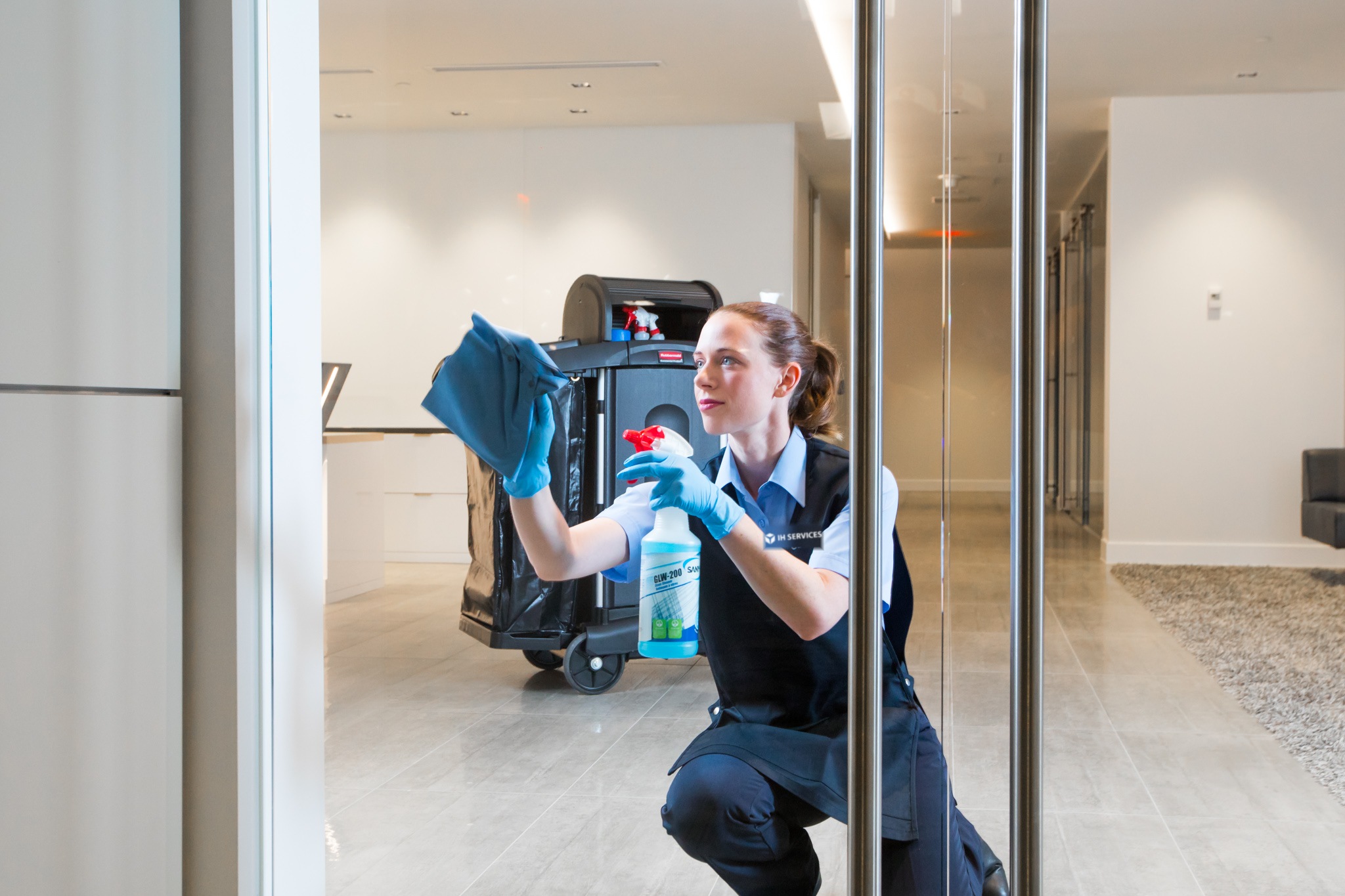
Cleared intelligence facility services, without the premium
Many sites assume a cleared facility crew costs more than it saves, so they keep supplying escorts instead. However, that assumption is usually right about the quotes they received and wrong about the economics. Specifically, two things make the difference at IH Services.
A wage differential, not a premium price
Instead, cleared IH employees earn a differential over the same role uncleared. That differential is what you pay for, and there is no separate “cleared” rate on top of it. In other words, the cost of a cleared crew is the differential minus the escort hours it takes off your books, and on most sites the second number is larger.
A cleared bench, so no one is untouchable
In addition, we ask to clear two or three employees beyond the number the site needs, and to have them approved for the space in advance. When performance slips, we bring in a replacement from the bench instead of keeping the person on because a new approval would take months. Consequently, no IH Services employee is ever captured by their own clearance.
The comparison to run: escort hours per month at the loaded cost of the employee doing the escorting, against the wage differential on the crew size your site needs. The escort cost calculator does the arithmetic from your own logs.
The compliance stack behind intelligence facility services
| Area | What the site expects | What we bring |
|---|---|---|
| Access | Personnel approved by the accrediting agency; windows and escort rules set by the special security officer | DoD Cleared Workforce; FSO trained to 32 CFR Part 117; sponsorship against the start date; fixed roster; access records that reconcile with yours |
| Physical standard | ICD 705 and site procedures for what enters the space | Approved tools and products only; no electronics inside the boundary; procedure agreed with the special security officer before the first visit |
| Registration | Identity in federal and prime supplier systems | SAM registered; CAGE 1JXW7; UEI EGR9H17YE9H3; full qualification record |
| Information | Protection of contract information and CUI on vendor systems | NIST SP 800-171 alignment; response to any CMMC level a flow-down names |
| Quality | Evidence for the security office and inspection teams | Completion, access, and corrective-action records from R3 Secure FacilityOps |
| Safety | Recordable rates and a trained program | 5-4-0 safety program; EMR 0.90; 2026 TRIR 1.45 |
Of course, details on each line are on the certifications and compliance page. For the physical standard, see ICD 705 as published by the Office of the Director of National Intelligence. Scope note: our work stops at the production or process equipment line, as always. Facility systems, building envelope, housekeeping, and waste are ours, while the equipment is yours. Corrugate removal and recycling is the one task that crosses into production space.
Intelligence facility services, by scope
Cleared custodial inside accredited spaces
First, SCIFs, special access program facilities, and the controlled areas around them, cleaned by approved staff with documented access. Secure-space custodial
Cleared MEP maintenance
Likewise, HVAC plant, electrical distribution, plumbing, lighting, and building systems, preventive first, with completion records. Cleared MEP
Industrial housekeeping
Also, production-floor housekeeping under FOD, ESD, energetics, and contamination-control programs. Industrial housekeeping
Grounds, exterior, and waste
Finally, grounds and snow, exterior, facility waste streams, and corrugate removal and recycling on the production floor.
Three ways to start
Facility Reliability Readiness Scan
First, ten days, one site: deferred-maintenance backlog, reactive-work share, energy quick wins, and a one-page risk register. Built for facility and operations leaders.
Secure Facility Maintenance Risk Review
Then, with your special security officer: escort-hour burden, access documentation, and cleared-workforce capacity against the site’s schedule. Built for security leaders.
Scope Baseline
Finally, every recurring task in the current facility scope, classified by the value it carries, with protected cost, recoverable cost, and a Scope Value Index. Built for sourcing and finance. How it works
Each one starts with a 20-minute scoping call, and we agree an NDA before any site visit or document changes hands. None of them requires a commitment beyond that call.
Questions security officers ask about intelligence facility services
What are intelligence facility services?
Custodial, industrial housekeeping, grounds, waste, and mechanical, electrical, and plumbing maintenance delivered inside and around accredited spaces: Sensitive Compartmented Information Facilities, special access program facilities, and the controlled areas that support them. The accrediting agency and the site’s special security officer set the access rules, the approved windows, and the records each visit must leave. IH Services staffs that work with its own employees under a dedicated Facility Security Officer.
Which facility services companies can work inside a SCIF?
Few, because the work requires three things at once. First, personnel the accrediting agency has approved for the space, which usually means a clearance at or above the level of the SCIF or an escort who holds one. Second, a company security program that can sponsor, maintain, and report on those approvals. Third, crews that are the company’s own employees, so the roster the special security officer approved is the roster that shows up. IH Services runs its program through a dedicated FSO trained to 32 CFR Part 117 under DCSA, and self-performs the work.
What rules govern cleaning and maintenance inside a SCIF?
Intelligence Community Directive 705 and its technical specifications set the physical standard for a SCIF; the accrediting agency and the site’s special security officer apply them. For facility work, that means approved personnel only, work during approved windows with classified material secured, no unapproved tools or electronics inside the space, and an access record for every entry. So, IH Services agrees the procedure with your special security officer before the first visit and follows it as written.
Can uncleared staff maintain the HVAC or plumbing serving a SCIF?
Only under the escort and window rules the accrediting agency sets, and often not at all inside the accredited boundary. In practice, many sites keep uncleared vendors to the mechanical rooms outside the space and require cleared personnel or escorts for anything inside it. IH Services staffs the inside work from its DoD Cleared Workforce where the site’s rules allow, which removes the escort from your own staff’s day.
How are facility visits to an accredited space documented?
Through three records. First, an access record for each entry: who, the approved window, who escorted if the space required one, and time in and out, kept so it reconciles with the site’s own log. Second, a completion record for each task performed, with photo evidence only where the special security officer permits cameras, which inside a SCIF is usually never. Third, a corrective-action record with root cause and closure. R3 Secure FacilityOps produces all three in the format the site specifies.
What proof does IH Services publish?
99 percent on-time work-order completion, 98 percent client retention, 100 percent of client-defined reduction targets met, and a seven-year contract renewal by a New York defense and aerospace client in March 2026. For safety, EMR 0.90 and 2026 TRIR 1.45. Also, references are available under NDA on request. Specifics about our personnel go to your security office through our FSO, not onto a web page.
Which accredited space is carrying the most escort hours right now?
Start there. After all, a 20-minute call is enough to scope a Readiness Scan or a Secure Facility Risk Review for that site.