
The people with the most unsupervised access to your plant are often the ones your insider threat program thinks about least. Insider threat and facility services meet at 2 a.m., when a custodian with a master key is alone in your program office.
To be clear, that’s not an accusation. The overwhelming majority of facility workers are honest, careful, and proud of what they protect. However, an insider threat program isn’t built for the majority. It’s built for the exception, and for the mistakes honest people make when nobody trained them.
So start with a plain question. When your security office briefs the workforce on insider threat, does the night crew get the briefing?
Why Facility Services Belong in Insider Threat Planning
CISA’s insider threat mitigation guidance describes an insider threat as “typically a current or former employee, third-party contractor, or business partner” with access to an organization’s systems, data, or premises. Facility services staff fit that description exactly.
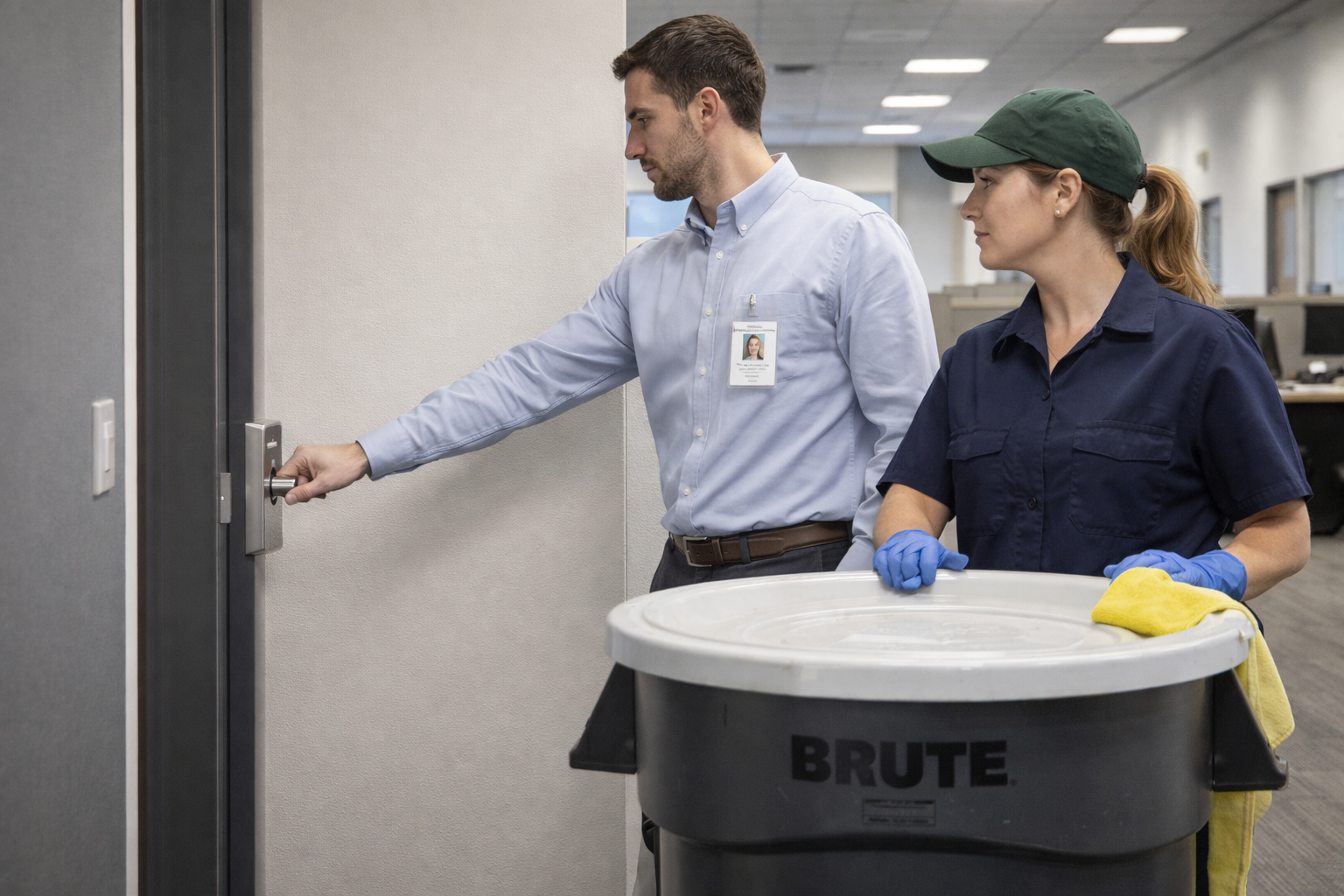
Now consider what they can reach. For example, custodians enter offices, labs, and storage rooms after hours. Likewise, maintenance technicians open ceilings, telecom closets, and mechanical rooms. In addition, both see whiteboards, printouts, and screens left on. Both carry keys and badges that open more doors than most engineers ever use.
For cleared contractors, the National Industrial Security Program rules at 32 CFR 117.7 require an insider threat program led by a designated senior official. The question is whether that program’s reach matches your facility’s reality. If the program covers your employees but not the vendor staff with master keys, it has a hole exactly where access is highest.
Three Insider Threat Facility Services Risks
Of course, not every insider risk is malicious. In facility services, most aren’t. They fall into three groups.
1. The Careless Insider
For instance, a custodian props a secure door open to move a cart. A technician leaves a ceiling tile off over a restricted room. Nobody meant harm. Even so, the access control just failed. Fortunately, this is the most common risk, and training fixes most of it.
2. The Unknowing Insider
Imagine someone asks a friendly question at a bar. “What do they build in that building you clean?” A worker who was never briefed doesn’t recognize elicitation when it happens. They share something harmless-sounding that isn’t harmless at all.
3. The Unwatched Insider
Finally, this is the rare one. A person with access, a grievance, and no one paying attention. Unfortunately, vendor turnover makes it harder to see. A worker who leaves one vendor and joins another may keep showing up at your site under a new badge, and your program never connects the dots.
What to Include: An Insider Threat Checklist for Facility Services
| Control | What it means for facility staff | Who owns it |
|---|---|---|
| Briefings | Every custodial and maintenance worker receives insider threat and elicitation awareness training before access, and annually after | Vendor, verified by your security office |
| Least access | Keys and badges match each person’s actual route, not a master key “just in case” | Your security office |
| Departure reporting | Vendor reports departures and role changes within a set timeframe so access ends the same day | Vendor |
| Reporting channel | Facility staff know how to report a concern and who to tell | Your security office and the vendor |
| After-hours rules | Clean-desk expectations for your staff, and clear rules on what facility crews may touch or move | Your security office |
| Roster continuity | A single, stable roster you can review, instead of rotating subcontractor crews | Vendor |
Fewer Faces, Stronger Insider Threat Facility Services Controls
After all, every additional vendor adds another workforce to brief, another HR process to trust, and another roster that changes without your knowledge. That’s the fragmented vendor problem applied to people.
By contrast, a single self-performed team narrows the field. You get fewer people to brief, one departure process, and one point of contact when something feels wrong. At IH Services, our Facility Security Officer, Racheal Prutch, previously served six years as the company’s Insider Threat Senior Official. That experience shapes how our crews are briefed and how our government custodial services teams operate.
Questions Buyers Ask About Insider Threat and Facility Services
Are contractors and vendors considered insiders?
Yes. CISA’s guidance describes insider threats as including current or former employees, third-party contractors, and business partners with access to an organization’s systems, data, or premises.
Do custodial and maintenance workers need insider threat training?
If they have access to sensitive areas, they should receive awareness training covering insider threat indicators, elicitation, and how to report a concern. Confirm the specific requirement with your security office.
What is the most common insider risk from facility staff?
Usually carelessness, not malice. Propped doors, unsecured ceiling access, and moved materials cause most incidents. Training and clear after-hours rules prevent most of them.
How does vendor turnover affect insider threat?
Simply put, high turnover makes it harder to track who has access and to notice warning signs. Fast departure reporting and a stable, single-vendor roster reduce that blind spot.
Extend Your Program to the Night Shift
In short, your insider threat program already protects the day. Make sure it reaches the people who hold the keys after everyone else goes home. Brief them, limit their access to what the job needs, and give them a way to speak up.
Want to check whether your facility vendors are inside your program or outside it? Contact our team to talk it through.
This article is general information. Follow the requirements of your cognizant security agency and your approved security procedures.