
Where Does Risk Hide in a Secure Facility?
Secure facilities rarely fail because one technician makes a mistake. Instead, they fail at transition points—between vendors, between systems, between responsibilities. For example, mechanical systems may operate under one contract. Electrical services under another. Janitorial under a third. Life-safety under yet another. Each vendor may perform adequately. Yet few operate as a unified system, and that is the gap integrated operations and maintenance closes.
In short, it removes these seams by putting all services under one operating framework.
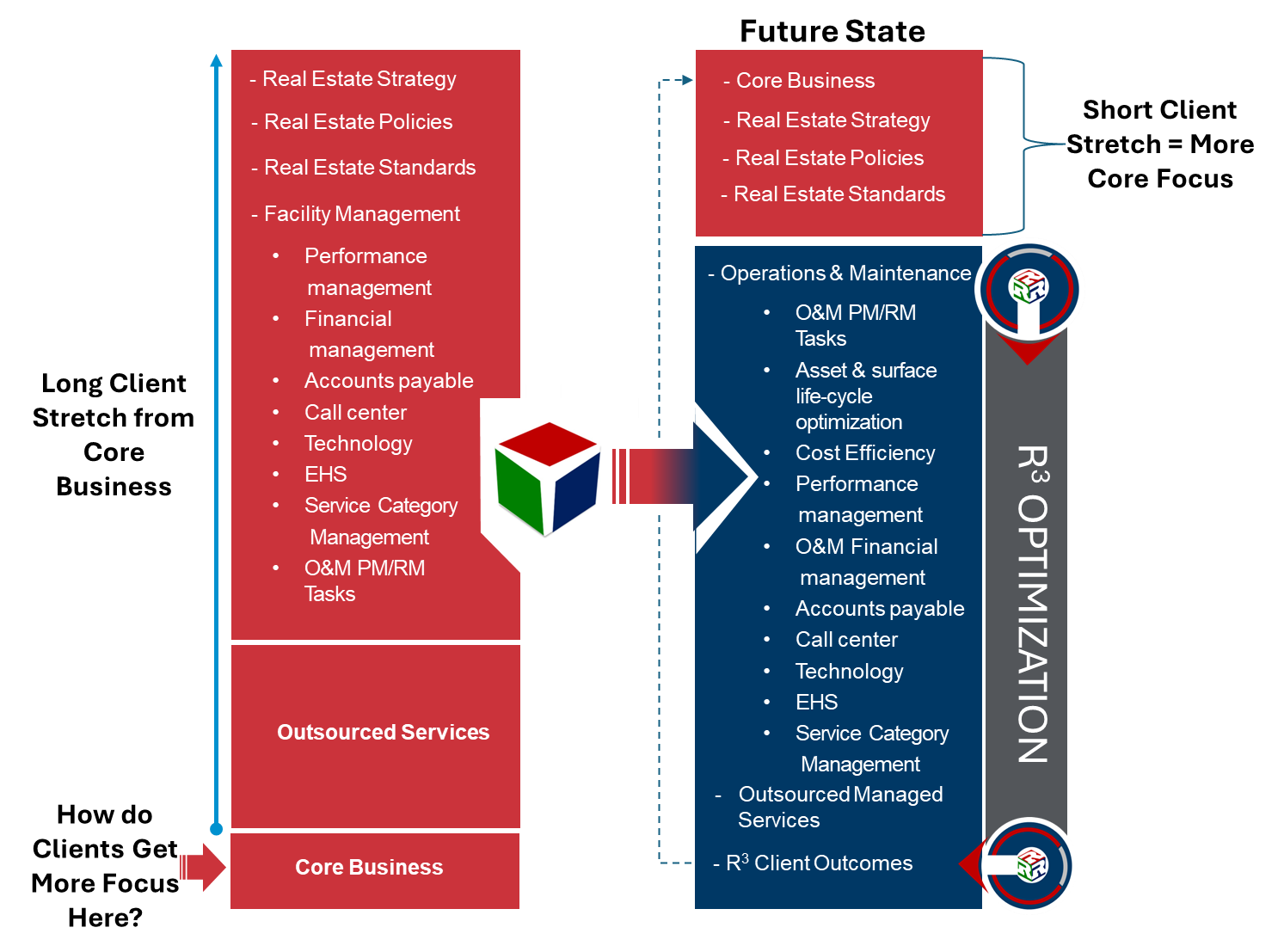
The Limits of Fragmented Delivery
Traditional facility models grew up in commercial real estate, where people accept far more risk than secure operations can.
Fragmented delivery creates:
- Scope ambiguity during incidents
- Delayed escalation across vendors
- Disconnected reporting systems
- Competing performance metrics
- Diffused accountability
It resembles an orchestra without a conductor. Each instrument plays correctly. Still, the music as a whole lacks coordination.
Secure facilities cannot operate this way. We lay out the data behind this in why fragmented facility vendors increase risk.
What Does Integrated Operations and Maintenance Require?
Integrated O&M is not contract bundling. Instead, it is structural unification.
A true integrated model includes:
- A single governance framework
- One performance dashboard
- Unified dispatch and escalation protocols
- Standardized SOPs across trades
- One accountable partner
As a result, integration replaces coordination complexity with structural control.
What Changes When You Integrate Operations and Maintenance?
Secure facilities that run under an integrated model see measurable improvements.
Compressed Response Time
When all services operate within the same system:
- Work orders route immediately
- Escalations follow predefined pathways
- Cleared personnel deploy without vendor delay
As a result, response becomes procedural rather than improvised.
Engineered Reliability
Integration also aligns preventive schedules, corrective tracking, and performance measurement.
Consequently, this alignment produces:
- Higher preventive compliance
- Reduced corrective recurrence
- Consistent execution across sites
Reliability becomes designed, not accidental. The U.S. Department of Energy’s Operations and Maintenance Best Practices Guide estimates that preventive maintenance saves 12% to 18% compared with reactive maintenance. Integration is how you hold that discipline across every trade.
Audit-Defensible Documentation
Similarly, a unified system produces:
- Centralized documentation
- Standardized reporting
- Clear ownership of outcomes
Audits review one structure—not a collection of vendor submissions. See audit-ready facility services for what that looks like day to day.
Reduced Total Cost of Ownership
Finally, integration removes:
- Subcontractor markups
- Administrative duplication
- Coordination overhead
- Scope overlap
So savings come from structure rather than service cuts.
How Do You Move to Integrated Operations and Maintenance?
You don’t flip a switch. Instead, you move in phases, so the building never feels the change.
- Map the seams. List every vendor, every scope, and every handoff between them. Mark the handoffs that touch critical assets or restricted areas. Those go first.
- Set one baseline. Pull 12 months of work orders, response times, and preventive maintenance completion. You can’t prove improvement without a starting point.
- Transition by risk, not by contract date. Bring critical hard services under one team first. Fold in custodial, grounds, and specialty work as each contract ends.
- Report one scorecard. One dashboard, one set of definitions, one monthly review. When a number moves, you know exactly who to call.
Done this way, integration lowers your risk during the change instead of adding to it. IH Services self-performs cleared maintenance, government custodial services, and grounds under one team for exactly this reason.
Is Integrated Operations and Maintenance Right for Your Site?
It fits best when three conditions are true. First, you run three or more facility vendors in or near restricted areas. Second, escorts, access, or handoffs regularly slow down repairs. Third, your team spends real time each week coordinating vendors instead of improving the facility.
If two of those three sound familiar, integration will likely pay for itself in control alone. Even so, start with the data. Map the seams, set a baseline, and then compare your current model with an integrated one on total cost, not just price.
Why Broker Models Fall Short in Secure Environments
Broker-based facility providers coordinate vendors but rarely control execution. In secure spaces, this often leads to:
- Clearance delays
- Limited visibility into field performance
- Reduced operational control
- Slower incident containment
Secure facilities require execution certainty. Integration, however, restores that certainty.
Control Is Structural
Secure facilities operate under strict compliance, uptime pressure, and zero tolerance for failure. So managing them through fragmented vendors invites exposure. Integrated operations and maintenance, by contrast, provides one operating system, one governance structure, and one accountable partner—transforming facility services from vendor management into operational control.
Schedule a Secure Facility Walkthrough to evaluate whether your current model strengthens—or fragments—control within your operations.
Questions Buyers Ask About Integrated Operations and Maintenance
What is integrated operations and maintenance?
Integrated operations and maintenance puts mechanical, electrical, custodial, grounds, and life-safety work under one team, one governance structure, and one performance dashboard. Instead of coordinating several vendors, you hold one partner accountable for uptime, response, and documentation across every trade.
How is integrated O&M different from bundling contracts?
Bundling simply puts several vendors on one contract. By contrast, integration puts every trade under one operating system: shared dispatch, standard procedures, one set of records, and one accountable manager. A bundled contract can still hide the same handoffs and blind spots that fragmented vendors create.
Does integrated operations and maintenance cost more?
The price can look higher on a bid sheet because it includes coordination work your own staff does today. However, total cost is often lower once you count staff time, escort hours, subcontractor markups, and downtime. Compare total cost, not line-item price.