
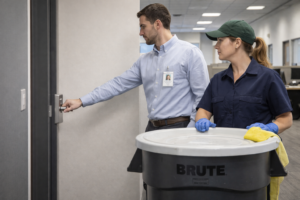
 Escort-dependent maintenance is often treated as a security necessity. In practice, it is one of the most overlooked sources of operational waste in secure facilities.
While escorts protect access, reliance on uncleared maintenance labor (from janitors to HVAC technicians) introduces delays, cost inflation, and operational fragility—none of which appear clearly in budgets or service reports.
This article examines the true cost of escort-dependent maintenance and why secure facilities increasingly view cleared workforces as an operational requirement, not a luxury.
The Visible Costs Are Only the Beginning
Escort-dependent maintenance visibly consumes:
- Security personnel time
- Scheduling effort
- Access coordination
These costs are typically absorbed into overhead and rarely challenged.
The real impact lies beneath the surface.
The Hidden Operational Costs
- Delayed Response and Extended Downtime
Maintenance work cannot begin until escorts are available. In secure environments, this results in:
- Missed service windows
- Deferred repairs
- Extended asset downtime
Downtime costs rarely appear on maintenance invoices—but they directly affect mission continuity.
- Inflated Labor and Administrative Overhead
Escort dependency multiplies labor inputs:
- One technician becomes two resources
- Security schedules dictate maintenance timing
- After-hours work becomes routine
The facility pays for inefficiency without seeing it itemized.
- Reduced Preventive Maintenance Effectiveness
Preventive maintenance requires predictability. Escort dependency introduces friction that pushes teams toward:
- Reactive service calls
- Deferred inspections
- Short-term fixes
Over time, assets degrade faster and corrective costs rise.
Why Cleared Workforces Change the Equation
A workforce authorized to operate independently in secure spaces eliminates an entire layer of non-value-added activity.
Operational benefits include:
- Immediate response capability
- Predictable maintenance schedules
- Reduced security burden
- Lower total cost of ownership
Most importantly, cleared teams restore operational control to the facility.
Reframing the Decision
The question is not whether escort-dependent maintenance is permissible. It is whether it is operationally defensible.
In secure environments:
- Time is risk
- Delay is exposure
- Inefficiency compounds quietly
Cleared workforces are not a premium feature—they are a structural risk reduction mechanism.
Escort-dependent maintenance masks its true cost behind process complexity and budget silos. Over time, it erodes responsiveness, inflates operating expense, and weakens facility readiness. Secure facilities that prioritize mission continuity increasingly eliminate escort dependency wherever possible—not to reduce security, but to strengthen operations.
Calculate Escort Cost Exposure to quantify the hidden operational impact within your facilities.